A New System for Business Strategy in the AI Age
35 elements across 12 business models, 6 competitive advantages, 17 strategies. One framework for writing your strategy down and stress-testing it against AI disruption.
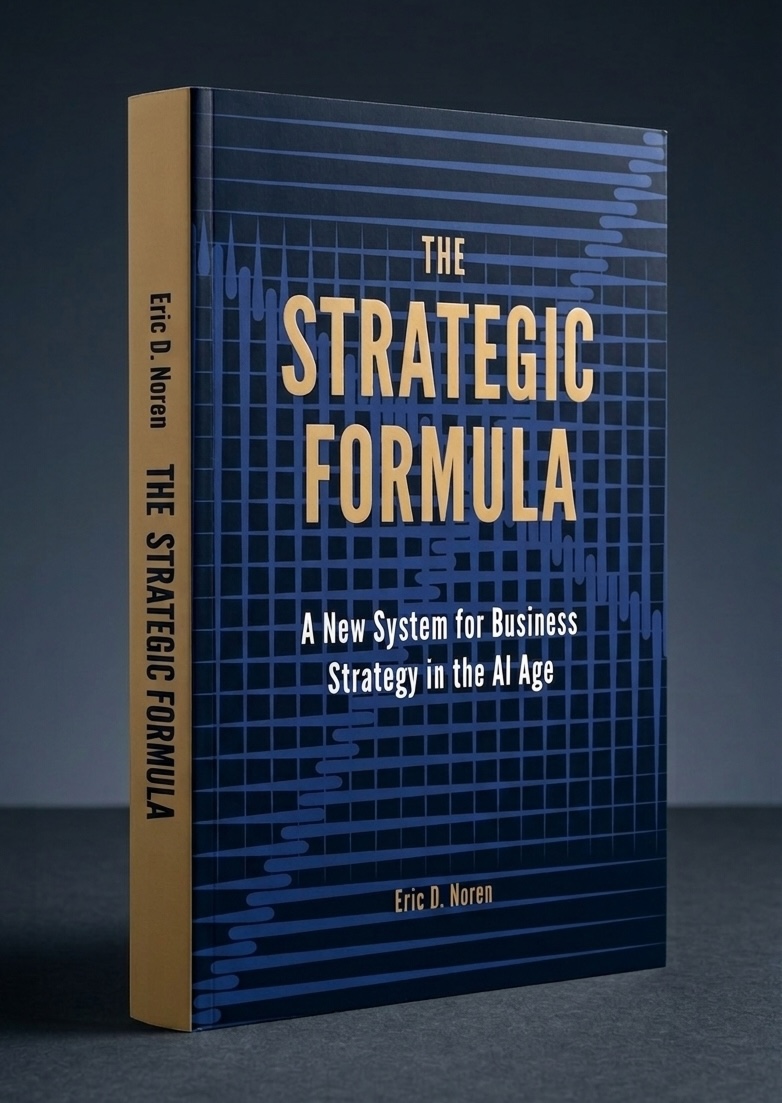
Ask everyone in the room to write one sentence: how does this company actually compete? Not the mission statement, not the market positioning slide — a single structured statement specific enough that a new executive could read it and know exactly what the company is and isn't doing.
Then compare the answers.
In most rooms, they don't match. One leader describes a premium brand. Another describes a cost structure. A third claims a competitive advantage that two others would quietly call an aspiration. The divergence is rarely surfaced. It shows up instead in resource allocation decisions that pull in different directions, in technology investments with no structural logic connecting them to the company's actual strategic formula, in strategy offsites that produce a list of priorities no one can trace back to how the company actually competes.
When was the last time your leadership team wrote that sentence — and agreed on it?
Most teams haven't. And the ones that try often discover a harder truth: they can't honestly name a competitive advantage. They have execution. They have momentum. They may have market position. But nothing that would structurally protect them if a well-resourced competitor pressed hard — or if AI reshuffled the deck.
If you've already read Business Model Generation and 7 Powers and wondered why the pieces don't fit together, that's the gap this book was built to close.
The Strategic Formula was built for that moment of honest diagnosis. And then it asks the next question: how much of your strategy survives AI disruption?
1. Write your strategy as a precise, testable formula. Not a slide deck, not a mission statement — a single structured statement specific enough that any executive on your team could read it and know exactly what the company is and isn't doing.
2. Name your true competitive advantage — or diagnose that you don't have one yet. The framework distinguishes between what you're good at and what's structurally protecting your position. That distinction matters more than most leaders realize, especially when conditions shift.
3. Facilitate strategy conversations that move from opinion to structure. When your team shares a vocabulary — where "business model," "strategy," and "competitive advantage" mean precisely the same thing to everyone in the room — the conversation shifts from defending positions to interrogating structure. That's a fundamentally different kind of meeting.
4. Translate your strategic formula into specific executional priorities. Each of the 35 elements carries a set of Critical Success Factors that identify where executional effort, investment, and coordination are most structurally demanded by your formula. When those factors overlap across elements, the system surfaces them — revealing where your formula's performance is most concentrated, and where its fragility is visibly embedded.
5. Score every element of your strategy for AI disruption. The AI Susceptibility Index produces a clear score: here's where you're exposed, here's where you're structurally protected, and here's where you need to make decisions before the pressure arrives rather than after.
6. Determine whether your business is positioned to build a learning loop. The three structural preconditions for compounding advantage in the AI era give you a concrete diagnostic lens rather than a vague aspiration.
The foundation is a 35-element taxonomy — 12 business models, 6 competitive advantages, and 17 strategies — that gives any leadership team a shared vocabulary for the questions strategy actually requires. When everyone in the room is using the same words to mean the same things, the conversation shifts from defending positions to interrogating structure.
Two companies in the same industry can have radically different AI exposure depending on what their strategic formula is built on. A business protected by genuine switching costs scores very differently than one whose core value proposition is generic and digitizable.
The Strategic Formula overlays two original tools on every element in your formula:
AI Susceptibility Index (ASI). Scores every element across five dimensions — digitizability, data intensity, automation potential, network-effect sensitivity, and capital reallocation friction — producing a heat map of where your formula carries higher and lower AI exposure. Replaces vague AI anxiety with a specific, actionable diagnosis.
Learning-Loop Economics. A theory of compounding advantage in the AI era. Most leaders assume scale creates a data advantage. It doesn't — not automatically. Learning-Loop Economics identifies the three structural conditions required to build a self-reinforcing loop: exclusive data capture, tight architectural integration, and rapid feedback tempo. If any one is missing, you don't have a compounding loop. You have a data project.
Not a case study collection. Real companies appear as examples, but the examples exist to demonstrate the diagnostic method, not to be copied. The goal is a way of seeing that applies to any business.
Not a prescription. The 35 elements are neutral — none are inherently right or wrong. The system doesn't tell you what strategy to pursue, because the right answer depends on your specific formula, your industry, and your position. What it does provide is the diagnostic clarity to make that decision from structure rather than instinct — and the Critical Success Factors tied to each element, which identify exactly where executional effort and investment must concentrate given your particular combination.
Not a replacement for execution. The framework is designed to precede execution — to ensure that when your team starts executing, they're executing the right strategic formula. The Critical Success Factors built into each element translate the diagnostic into executional priorities, but the book stops there by design.
Not an AI theory book. The AI tools in the book are practical: the ASI scores every element for disruption exposure, and Learning-Loop Economics explains the structural conditions that make some strategic formulas compound while others stall. Both are applied diagnostics, not theory for its own sake.
Not a summary of other frameworks. Porter's Five Forces, the Business Model Canvas, 7 Powers — the book builds on several of them. The Strategic Formula connects what they each do well into a single composable vocabulary. If you've read those books and wished the pieces fit together into one system, that's the gap this book is designed to close.
Not for the leader who wants confirmation. The diagnostic is honest. A lot of leadership teams run the strategic formula exercise and discover they can't name a genuine competitive advantage. The system calls that state Operational Parity — a valid diagnosis, not a failure. But the diagnosis is uncomfortable, and the book doesn't soften it.
What it is: A diagnostic system that gives leaders a shared vocabulary to name exactly how their business competes, stress-tests that formula for the AI era, and identifies where structural dependencies concentrate and where configurations are fragile — before they execute.
The Strategic Formula is not a theory book. It is a practitioner toolkit — built for offsites, board decks, and consulting engagements. 62 diagrams. 14 tables. A visual reference ready to use immediately, without setup.
The framework has been developed and tested in real strategy work over more than a decade. It is the natural companion to Business Model Generation — adding the "moat" and the "move" to the canvas — and the AI-native complement to 7 Powers, connecting durable competitive advantage to the specific pressures reshaping business today.
The Critical Success Factors built into each element translate the diagnostic into executional priorities — identifying exactly where effort, investment, and coordination must concentrate given your specific formula. The book gives you the diagnostic and the brief. Execution is yours.
Book details:
1999–2004 — The question that started everything. The internet was reshaping how companies reached customers and captured value. The question that stayed with Eric was whether any of this was actually new — new business models, or new implementations of existing ones. He started a running file: take a company, write down how it makes money, try to classify it.
2008–2010 — Competitive advantage enters the picture. Bruce Greenwald's Competition Demystified provided a precise account of competitive advantage — the best bounded list Eric had seen. Business Model Generation followed in 2010. The visual format was compelling, but it was a design tool, not a classification system. A second layer had formed.
2010–2019 — Testing the system in real strategic work. The three categories — business models, competitive advantages, and strategies — developed gradually through repeated application, failure, and refinement. In 2016, the system was first formalized through The Business Model Design Studio, a website and a 74-page consulting methodology. The project went dormant and returned multiple times through the years.
2023 — The periodic table framing arrives. In March 2023, the unifying structure clicked. On April 25, 2023, Eric published the first version of the Periodic Table of Business Strategy on Substack. That version had 54 elements. The Bankshot Strategy newsletter became the testing layer.
2025 — The table is consolidated. The book becomes possible. Revisiting the table revealed structural redundancy. Critical Success Factors served as an auditing mechanism. 54 elements consolidated to 35 — no elements lost, no new ones added. AI tools grew more capable. The strategic formula notation — (Business Model + Strategy) × Competitive Advantage — crystallized during this period. Competitive advantage had been treated as additive in every previous version. Working through the definitions made clear why it was multiplicative. The AI Susceptibility Index and Learning-Loop Economics emerged as the second half of the book.
August 4, 2026 — Publication. AI did not create the need for this system. AI made the need impossible to defer.
Builds on Business Model Generation. Osterwalder's canvas made business model design visual and accessible. The Strategic Formula takes the next step: adding the moat and the move. The canvas describes what a business does; the formula names what makes that position durable and how AI threatens to erode it.
The AI-native complement to 7 Powers. Helmer identified the conditions that create durable competitive advantage. The Strategic Formula integrates those conditions into a complete system — connecting moats to business model design, strategies, and AI scoring within a single composable formula that moves from diagnosis to execution.
The upstream diagnostic for Rewired. McKinsey's execution playbook is built for organizations that know what they're transforming. The Strategic Formula is the prior step — the diagnostic that makes the formula explicit before execution planning begins, so the team is executing the right thing.
For readers of Competing in the Age of AI who want a practitioner toolkit. Iansiti and Lakhani built the theoretical case for AI-first firms. The Strategic Formula translates that case into a hands-on diagnostic: 35 elements, a composable formula, and a scoring system you can use in a room.

Eric D. Noren is a strategist, author, and creator of the Periodic Table of Business Strategy — a 35-element diagnostic framework for understanding how businesses compete. His book, The Strategic Formula: A New System for Business Strategy in the AI Age (August 2026), gives leaders a composable system to define their strategic formula, stress-test it against AI disruption, and build toward compounding advantage.
Eric D. Noren is a strategist with more than 20 years of experience at the intersection of marketing, technology, and business strategy, working across small companies and Fortune 500 enterprises. He has worked in both digital leadership and operational roles, and spent more than a decade testing and refining the strategic system at the foundation of this book across industries.
He began developing the formal framework in 2016, published the first version of the Periodic Table of Business Strategy on Substack in 2023, and refined it to its current 35-element structure in 2025. He writes Bankshot Strategy, a newsletter on competitive advantage, learning loops, and the changing physics of business in the AI era. He is based in the Houston area.
Read Bankshot Strategy on Substack.
The 35-element visual reference behind The Strategic Formula — free PDF download. Enter your email to get it now.
You'll also become a free subscriber to Bankshot Strategy, Eric's newsletter on competitive advantage and the business of AI. Unsubscribe anytime.
Who is The Strategic Formula for?
The primary audience is experienced leaders — C-suite executives, senior VPs, corporate strategy leaders, BU heads, and GMs — who need a more precise vocabulary for strategy and a structured way to test what they have. The book is also written for consultants and advisors who need a repeatable, visual diagnostic for workshops and client deliverables, and for strategists who report to executive leadership and need a framework that holds up in the room.
How is The Strategic Formula different from other strategy books?
Most strategy books offer sweeping theory or company case studies. The Strategic Formula provides a diagnostic system readers can apply to their own business. The foundation is a shared vocabulary — 35 defined elements that end the terminology debates that slow leadership teams down. Once the vocabulary is in place, the system builds a strategic formula, then stress-tests that formula against AI disruption using the AI Susceptibility Index. The other meaningful difference: every component — the Periodic Table, the formula notation, Learning-Loop Economics, the ASI, and the Critical Success Factors — operates on the same 35-element vocabulary. When readers move from diagnosis to execution, they are not switching frameworks.
Why should executives adopt The Strategic Formula instead of sticking with what they know?
The system is for organizations whose strategy lives in the instincts of the people who built it rather than in a structure anyone can read, test, or transfer. If leadership cannot write the strategy as a single explicit statement — specific enough that a new executive would know exactly what the company is and isn't doing — that is the problem The Strategic Formula solves. If a leadership team can already write that statement and agrees on it, they may not need the book.
Can The Strategic Formula be used for competitive analysis?
Yes. The same 35-element vocabulary used to diagnose a reader's own strategic formula can be applied to competitors, suppliers, distributors, and indirect substitutes — producing a structured, side-by-side comparison of how each player in an industry competes and where the gaps are.
By mapping each competitor's business model, strategy, and competitive advantage using the Periodic Table, leadership teams can move beyond intuitive assessments to a consistent, comparable read across an entire competitive landscape. The framework also surfaces what no one in the industry is doing — elements or strategies that no competitor has adopted — which can signal an opportunity worth investigating. The book walks through how to extend the analysis to ecosystem players and indirect competitors whose formulas may reshape customer expectations in ways direct competitors miss.
Does The Strategic Formula apply outside of large corporations?
The system applies to any organization that competes for resources, customers, or relevance — regardless of size, sector, or structure. The three core questions do not change based on organizational type: How does the organization create and deliver value? How does it compete or position itself for growth? What makes its position durable? Those questions apply equally to a founder-led startup, a nonprofit competing for grants and donors, a hospital system, or a Fortune 500 enterprise. For smaller organizations, the most valuable output is often the Operational Parity diagnosis — a clear view of whether the business is building toward something structurally defensible.
What's the difference between a business model, a strategy, and a competitive advantage?
A business model is the structural logic of how a business creates, delivers, and captures economic value — not a revenue tactic, not easily reversed. A strategy is the set of discretionary action patterns through which leadership chooses how to compete right now — reversible and distinct from the business model. A competitive advantage is a durable structural condition that allows a business to earn superior returns without requiring continuous reinvention. The diagnostic question: what makes it structurally difficult for a well-resourced competitor to replicate your position? Two companies can share the same business model and get completely different results. The Periodic Table of Business Strategy treats all three as distinct analytical questions.
How is The Strategic Formula different from Playing to Win?
Playing to Win is built for strategic coherence; The Strategic Formula is built for strategic durability. Playing to Win asks leadership teams to make five integrated choices, including "how to win" — but it does not provide a mechanism for assessing whether the answer will hold over time, or how AI-driven disruption affects specific elements of the strategy. The Strategic Formula is designed for that analysis. The AI Susceptibility Index scores every element for disruption exposure, and Learning-Loop Economics explains whether a strategy is positioned to compound or stall. For teams that have built coherent choices using Playing to Win, The Strategic Formula provides the stress-test for whether those choices will hold.
How is The Strategic Formula different from 7 Powers?
7 Powers identifies the conditions that create durable competitive advantage. The Strategic Formula integrates those conditions into a complete system — connecting moats to business model design, strategies, and AI scoring within a single composable formula. 7 Powers is moat-centric: it does not connect advantages to business model design, does not include AI-native tools, and does not provide a composable notation that moves from diagnosis to execution. For readers of 7 Powers who want a system they can apply in a room, The Strategic Formula is the next step.
How does The Strategic Formula fit with other strategy frameworks — Porter, BCG, OKRs?
Most strategy frameworks serve one function well — diagnosis, positioning, business model design, or execution measurement — but they were developed independently and analytical continuity breaks at every handoff. The Strategic Formula is an integration framework: every component operates on the same 35-element vocabulary. When the reader moves from diagnosis to execution, the language stays the same.
For a full comparison, see this functional comparison of business strategy frameworks.
Is there an eBook version?
Yes. The eBook is available in all standard formats (Kindle, ePub). The book includes 62 diagrams and 14 tables — the paperback is the recommended format for the full visual experience. The eBook is fully functional, but the diagrams are optimized for print.
Is the book available internationally?
Yes. The Strategic Formula is distributed internationally through IngramSpark and available on Amazon globally. Pricing and availability by country reflect standard Amazon international pricing.
Can I request a review copy?
Journalists, podcast hosts, and reviewers who would like a review copy in advance of publication should contact Eric here.
Did AI tools play a role in writing a book about AI strategy?
Yes. Eric used AI throughout the writing process — to stress-test the system, pressure-check definitions, and find internal inconsistencies. The pattern recognition and judgment are his; the synthesis and drafting acceleration are the machine's contribution. The process reinforced one of the book's central arguments: AI tools are most valuable when integrated tightly into a workflow with rapid feedback loops. That is Learning-Loop Economics applied to writing a book.
What is Bankshot Strategy?
Bankshot Strategy is Eric D. Noren's newsletter on competitive advantage and the business of AI, published on Substack. It applies the Strategic Formula System to real companies and industries — the ongoing conversation that extends the book's ideas into current competitive dynamics. The name reflects the analytical approach: a bank shot in billiards works through angles and timing rather than brute force. Bankshot Strategy is the primary channel for readers who want to engage with the system beyond the book.
Subscribe to Bankshot Strategy on Substack.
Is there a way to work with Eric directly?
For senior leaders who want the diagnostic applied to their own organization, Eric offers a limited advisory engagement called Strategic Breakpoint Analysis. It is designed for a specific moment: when performance is acceptable but confidence in the strategy is harder to justify, and when external conditions are shifting in ways that may be structurally consequential. Strategic Breakpoint Analysis is a diagnostic artifact — a brief that makes the internal logic of the strategy explicit, identifies key assumptions and dependencies, and describes specific structural failure modes. It does not prescribe actions. It creates the clarity that informs them.
If this describes your situation, contact Eric to discuss fit.